
The CSCA (来华留学本科入学学业水平测试, China Scholastic Competency Assessment) is a standardised examination for international applicants to bachelor’s programmes in China.
Under the current framework, Chinese Government Scholarship candidates take Mathematics and Professional Chinese. At institutions using CSCA, non-scholarship candidates also take Mathematics; Professional Chinese is required for Chinese-taught programmes. Physics and Chemistry depend on the degree subject.
Official parameters
| Parameter | Detail |
|---|---|
| Time | 90 minutes |
| Questions | 80 |
| Format | Multiple choice |
| Maximum score | 100 |
| Language | Chinese |
| Papers | Humanities Chinese or STEM Chinese |
| Delivery | Initially mainly remote online testing, with in-person centres being developed gradually |
| Fee | CNY 450 for one subject; CNY 700 for two or more |
Humanities Chinese is intended for humanities and social-science degrees; STEM Chinese covers science and engineering contexts. The university and programme determine which paper you need.
The published 2026 calendar includes sessions in January, March, April, June and December. A session can be changed or cancelled by official notice, so always check the notice for the individual sitting. Results are normally published within seven working days for online and in-person computer tests and within fourteen for paper tests.
How to interpret the section table
The official site fixes the overall format at 80 questions in 90 minutes, but may revise the internal distribution. The breakdown below reflects a practice format used for preparation. Confirm it against the current syllabus and sample test before your exam.
| Section | Task type | Questions | Number | Suggested time |
|---|---|---|---|---|
| 1 | Character recognition | 1–10 | 10 | 8 min |
| 2 | Word selection | 11–25 | 15 | 12 min |
| 3 | Synonyms and antonyms | 26–33 | 8 | 6 min |
| 4 | Text completion I | 34–38 | 5 | 7 min |
| 5 | Text completion II | 39–43 | 5 | 7 min |
| 6 | Text completion III | 44–49 | 6 | 8 min |
| 7 | Grammar | 50–70 | 21 | 20 min |
| 8 | Reading | 71–80 | 10 | 15 min |
That leaves time to revisit marked questions. Spending three minutes forcing one uncertain answer is usually worse than returning to it at the end.
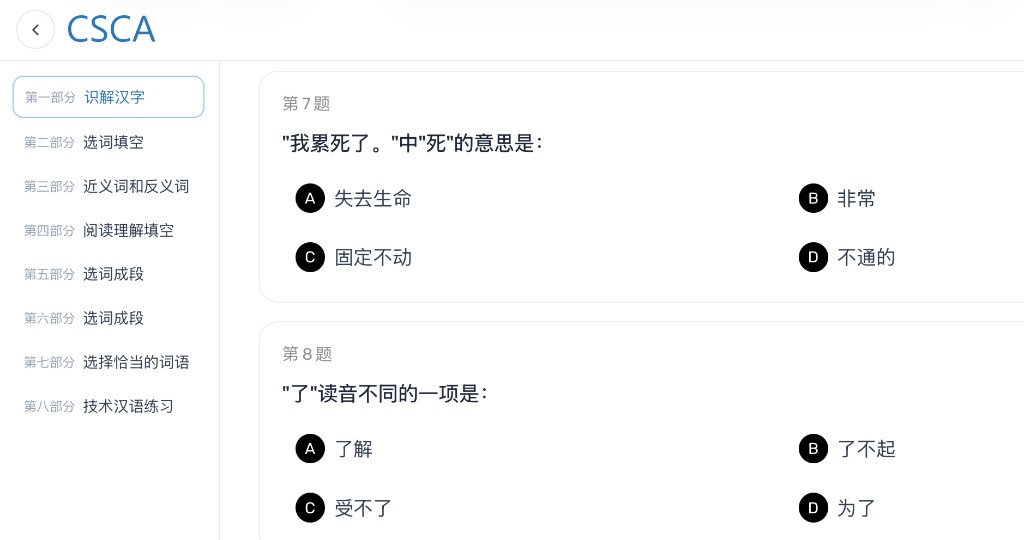
Section 1: character recognition
These questions test characters in context, distinctions between similar sounds or forms, and words with more than one meaning. Do not memorise an isolated English definition. Learn the word with its pronunciation, common collocations and an example sentence.
Section 2: word selection
In the practice format, several sentences share a word bank with one unused option. Meaning alone is not enough: pay attention to word class, register and natural collocation.
Section 3: synonyms and antonyms
Two words with the same broad translation may differ in intensity, formality, typical object or situation. Build contrast sets and record the sentence patterns in which each word actually appears.
Sections 4–6: text completion
These tasks test paragraph logic, connectors and the relationship between sentences. First identify what the missing element must do: introduce a contrast, continue an argument, give an example or close a sequence. Only then compare vocabulary.
Section 7: grammar
The practice paper includes selecting a suitable element and restoring word order. Review complements, particles, 把 and 被 constructions, comparisons, paired conjunctions and the order of adverbials.
Section 8: reading
Reading questions ask you to follow text structure, identify the central point, connect sentences and infer information. Alternate short timed drills with complete passages. Speed without a clear model of the paragraph is simply faster guessing.
Who needs Professional Chinese?
Under the current official framework:
- bachelor’s candidates applying for the Chinese Government Scholarship take it with Mathematics;
- non-CSC candidates applying to Chinese-taught programmes at institutions using CSCA take it;
- non-CSC candidates applying to English-taught programmes usually do not, although Mathematics remains compulsory within this CSCA framework;
- Physics and Chemistry are added according to the programme.
Do not assume HSK replaces CSCA, or vice versa. They are different tests. An exemption exists only when the university confirms it in writing.
How to prepare
- Open the current syllabus and sample paper on the official CSCA website.
- Confirm whether you need Humanities Chinese or STEM Chinese.
- Complete a full timed test and classify every mistake by task type.
- Review high-frequency grammar and vocabulary in context.
- Add subject-specific texts related to your intended degree.
- Practise moving on from a difficult question and returning later.
- One week before the exam, check the remote-testing rules, equipment and time zone.
Bottom line
Prepare for the examination the university actually requires, not for a remembered version of a sample paper. The reliable constants are the official syllabus, current session notice and programme requirements; everything else is a preparation aid that may change.
See also our guide to CSCA Mathematics, Physics and Chemistry and the comparison of Humanities Chinese and STEM Chinese.


