
About 210 minutes of testing, roughly 11,000 words in the new standard, news and academic texts, writing, translation and speaking: HSK 7–9 is a serious target. It is also unnecessary for many Chinese learners.
The useful question is not how prestigious the certificate looks. It is what the result will change in your education or career.
What is HSK 7–9?
Levels 7, 8 and 9 are assessed through one examination. The result awards HSK 7, 8, 9 or a category below level 7.
The official test contains 98 tasks across five assessed skills:
| Section | Time | What it assesses |
|---|---|---|
| Listening | about 30 min | news, negotiations, interviews, lectures and other complex material |
| Reading | 60 min | scientific, analytical, cultural and academic texts |
| Writing | 55 min | data description and analysis, argued writing |
| Translation | 41 min | written and oral translation into Chinese |
| Speaking | about 24 min | retelling and expressing a position |
Net testing time is about 210 minutes. With the scheduled break, the whole session lasts more than four hours. In 2026, the examination is available in internet-based format.
Fees and dates depend on the country and centre. Check the official registration system instead of relying on an old claim that it always costs a fixed dollar amount or runs twice a year.
What the tasks look like
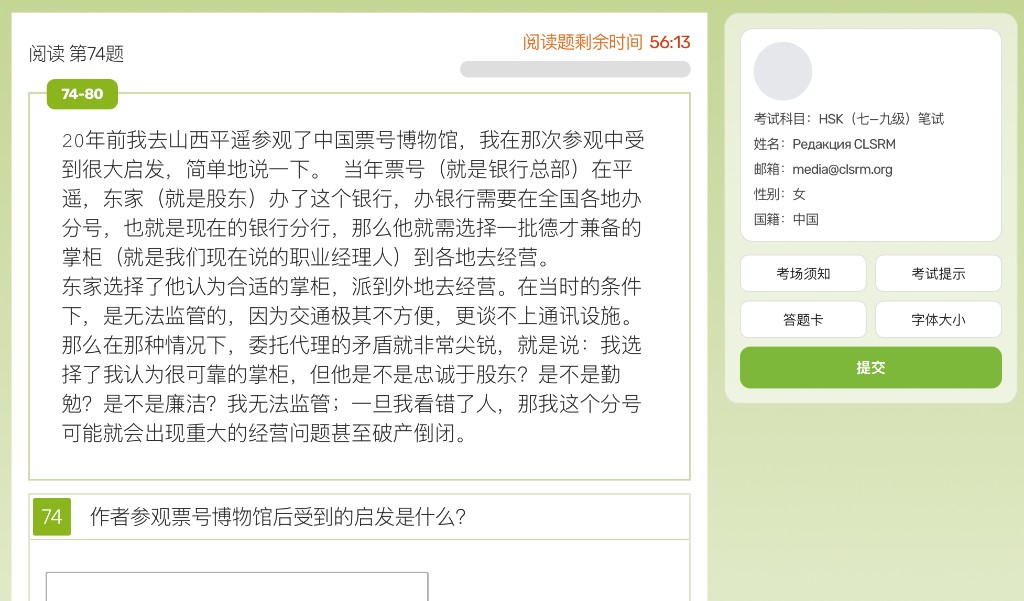
Reading. Sample materials include historical, business and cultural contexts in which you must follow the author’s reasoning.
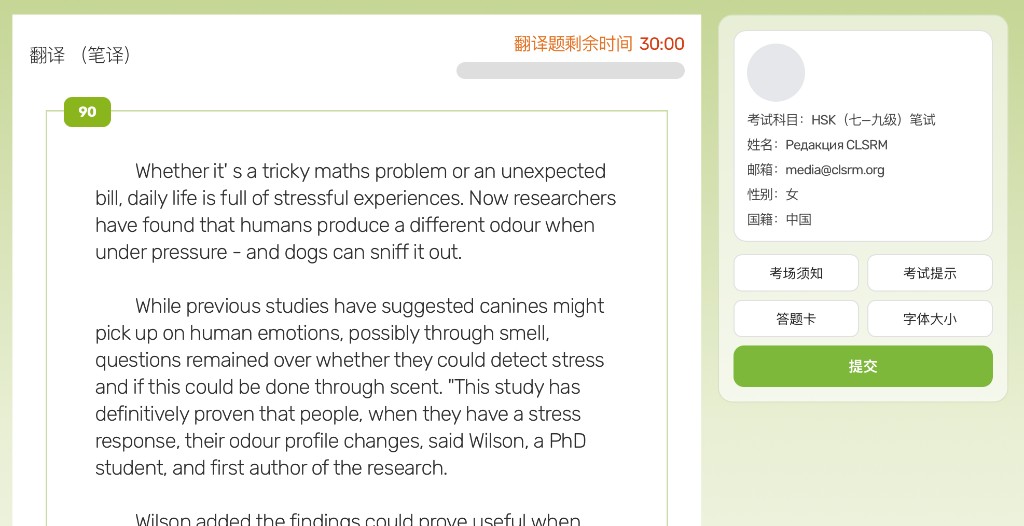
Translation. The candidate translates a coherent foreign-language text into Chinese. Available source languages depend on the official examination configuration.
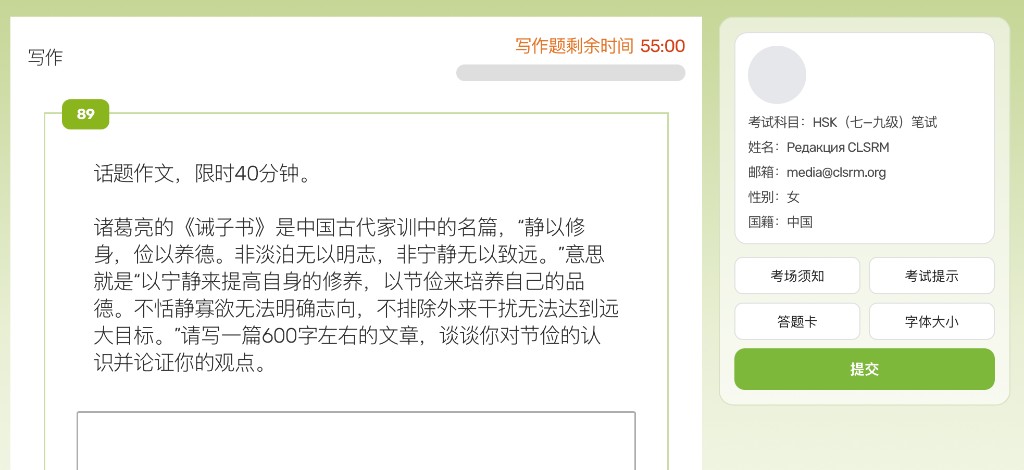
Writing. You must understand the source material and construct an argued response rather than reproduce a template.
This is advanced academic and professional Chinese. It is not identical to conversational fluency and does not prove competence in every industry.
Who may benefit from the certificate?
- master’s and doctoral students working with Chinese-language sources;
- Chinese-language teachers and sinology researchers;
- translators, editors and journalists;
- professionals who need a measurable advanced level for selection or internal assessment;
- students whose programme explicitly accepts or recommends HSK 7–9.
For these groups, the preparation can matter as much as the certificate: complex reading, structured writing, translation and public argument.
Who can normally stop at a lower level?
- most bachelor’s applicants whose university requires HSK 4 or 5;
- many master’s applicants whose programme requires HSK 5 or 6;
- professionals who need sector terminology and workplace communication more than a general examination;
- residents of China whose immediate goal is confident everyday conversation.
“Enough” always refers to a defined goal. HSK 6 may satisfy a formal threshold without preparing you to work freely with legal, medical or technical texts.
What preparation gives you
HSK 7–9 forces systematic work on skills learners often postpone:
- listening to news, lectures and interviews at a natural pace;
- reading long texts and finding the structure of an argument;
- writing coherent timed responses;
- translating meaning rather than isolated words;
- speaking without a memorised script.
That can make the test a valuable milestone even when an employer does not require it. The milestone still needs to justify the time it consumes.
What the examination does not measure fully
HSK 7–9 emphasises formal, academic and public professional language. It offers a weaker measure of:
- industry expertise;
- everyday slang and regional varieties;
- live negotiation ability;
- translation quality into your native language;
- performance in a specific job.
The test includes translation into Chinese. Many professional translators mainly translate into their native language, so an HSK result is not a complete professional translation qualification.
HSK 7–9 in the job market
HSK 7–9 appears in requirements much less often than HSK 5 or 6. It would still be wrong to claim that no university or employer asks for it: requirements change and individual programmes may adopt the newer levels.
Test the value for yourself:
- collect the requirements of the programmes and jobs you genuinely want;
- count how many explicitly mention HSK 7–9;
- compare the benefit with a portfolio, internship, publication or sector qualification.
Should you take it?
| Goal | What is usually more useful |
|---|---|
| Bachelor’s admission | the required HSK, CSCA and a strong application |
| Master’s admission | the programme’s HSK threshold, research plan and supervisor fit |
| Translation | HSK 7–9 plus a portfolio and specialist training |
| Academic career | advanced HSK, publications and source-based research |
| Business | industry terminology, negotiation and professional writing |
| Personal challenge | HSK 7–9 as a measurable long-term project |
If none of your target organisations requests the certificate, do not sit it merely to add a line to your CV. When the preparation directly supports the work you want to do, the examination becomes a useful tool.
What to do before, or instead of, HSK 7–9
- Turn HSK 5–6 knowledge into confident practical ability.
- Read in your field and build a specialist vocabulary.
- Write regularly with feedback from a teacher or editor.
- Create a portfolio of translations, articles, talks or projects.
- For bachelor’s admission, complete the required CSCA preparation.
Bottom line
HSK 7–9 is neither the automatic next step after HSK 6 nor a universal “native level.” It is an advanced examination for people who need academic reading, writing, translation and argued speech.
Define the result you want after the exam. If the certificate supports admission, selection or structured professional growth, it can be justified. Otherwise, a real project may demonstrate more.


